Wednesday, January 20, 2021

"Win Over All" - Rutgers 61 Notre Dame 59


Daily Home News - February 10, 1984

Our first two buzzer beaters were part of twenty win seasons that ended in post season play.   However, the nature of buzzer beaters is such that they aren't limited to any one type of season.  A year after Brian Ellerbe's winning shot against Temple, Rutgers was suffering the effects of losing multiple veteran players like Kevin Black, Roy Hinson and Rich Brunson.   On February 9, 1984, the Scarlet Knights were 8-11 at risk of the program's first losing record in 20 years.  Making things even more frustrating, five of the losses were by a total of 13 points.  One positive sign was the end of a five game losing streak thanks to a close win over George Washington due in part to some clutch foul shooting by junior forward Chris Remley.   Next up was a non-conference matchup with Notre Dame at the Continental Air Lines Arena in East Rutherford, the first basketball game ever between the two schools.  Notre Dame under Coach Digger Phelps had won eight of its last nine and sported a 15-6 record on the way, they hoped, to the NCAA tournament.

Asbury Park Press - February 10, 1984

Thanks to 15 points from Tom Sluby, Notre Dame was in charge most of the first half and led 32-24 at the break.  The Fighting Irish extended their lead early in the second half and were ahead 38-26 when Rutgers mounted a comeback.  After a Brian Ellerbe layup, Steve Perry hit a jumper and John Battle contributed a three point play to cut the margin to 38-33.  After that, however, Notre Dame regained control, extending the margin to nine with just 5:36 left in a game played without a shot clock.  Fortunately, the box and one defense, Rutgers employed to contain Sluby was proving effective since Notre Dame had not scored a basket in the last two minutes and would not score again from the field.  Even so Rutgers needed offense and, once again, Brian Ellerbe got things started with a corner jumper.  Steve Perry scored off another rebound (one of his eleven for the game) and then followed that by making three of four free throws to bring Rutgers within two.  Finally the Knights came all the way back to tie the game at 59-59 with 59 seconds left when John Battle hit both ends of a 1-1.

Record - February 10, 1984

Notre Dame was in possession and with no shot clock chose to hold the ball for what they hoped would be a game winning, preferably buzzer beating, shot.  With just 13 seconds left, Digger Phelps called timeout to set up their final possession.  Sluby made the inbounds pass to 6'10" Tim Kempton who tried to pass the ball back to Sluby, but Brian Ellerbe at 6'1" had other ideas.  The Rutgers guard darted in between the two Notre Dame players and deflected the ball towards the sideline.  He then jumped over and around the much taller Kempton without fouling and somehow got the ball to teammate Audra Bell without Kempton getting it first.  It was one of the greatest hustle plays I've seen in over 60 years of watching Rutgers basketball, reminiscent of a similar effort by Darius Griffith against UCLA on the very same floor.  Now it was Rutgers turn to take timeout to plan a game winning shot.  Understandably Coach Tom Young designed the play to go to John Battle who had already scored 23 points.  Equally understandably, Notre Dame had no intention of letting Battle beat them.  


Herald News - February 10, 1984

Record  - February 10, 1984

After inbounding the ball to Perry, Chris Remley got it back in the backcourt and dribbled into the forecourt looking for Battle who was closely guarded by Notre Dame.  Recognizing there wasn't time to pass the ball, the Rutgers junior continued to dribble to a point slightly to the left of the head of the key.  From 22 feet, Chris "just fired" what he called "a pretty good shot."  It was more than "pretty good." The ball swished through the basket with one second left leaving the Irish only a desperation pass that bounced harmlessly away.  In a classy post game comment, Kempton of Notre Dame said Rutgers won because "they outhustled us."  The rebounding figures support that view.  After being pounded on the boards 19-8 in the first half, Rutgers did a complete turnaround in the second half by exactly the same ratio.  Steve Perry led the way with 11 boards in addition to 12 points and John Battle led Rutgers in scoring with 23.  While it was not a league game, the win marked a turning point as the team won six of its next seven, ending the season with a 15-13 mark.  Non-conference or not, the magnitude of the win and especially the shot couldn't be under estimated.  As Chris Remley aptly put it - "That's tradition we beat, not just a team."


Courier News - February 10, 1984

The game winning shot was the second of Chris Remley's career, following one he made in a high school Christmas tournament, interestingly in Piscataway, although not at Rutgers.  Upon graduating from college, Chris was drafted by the Boston Celtics before going overseas to play professional basketball in both Ireland and Australia.  After two years in Australia, Remley returned to the United States and began a long teaching career in the Rahway, New Jersey public schools.  In addition to teaching, Chris has enjoyed an almost 30 year coaching career in multiple sports including tennis, golf, boys and girls soccer and, of course, basketball.  He has the distinction of being the second high school coach in New Jersey sports history to have won a sectional  championship in both boys and girls basketball.  

Tuesday, January 19, 2021

Lou Goetz - R.I.P.


Rutgers Targum February 1969

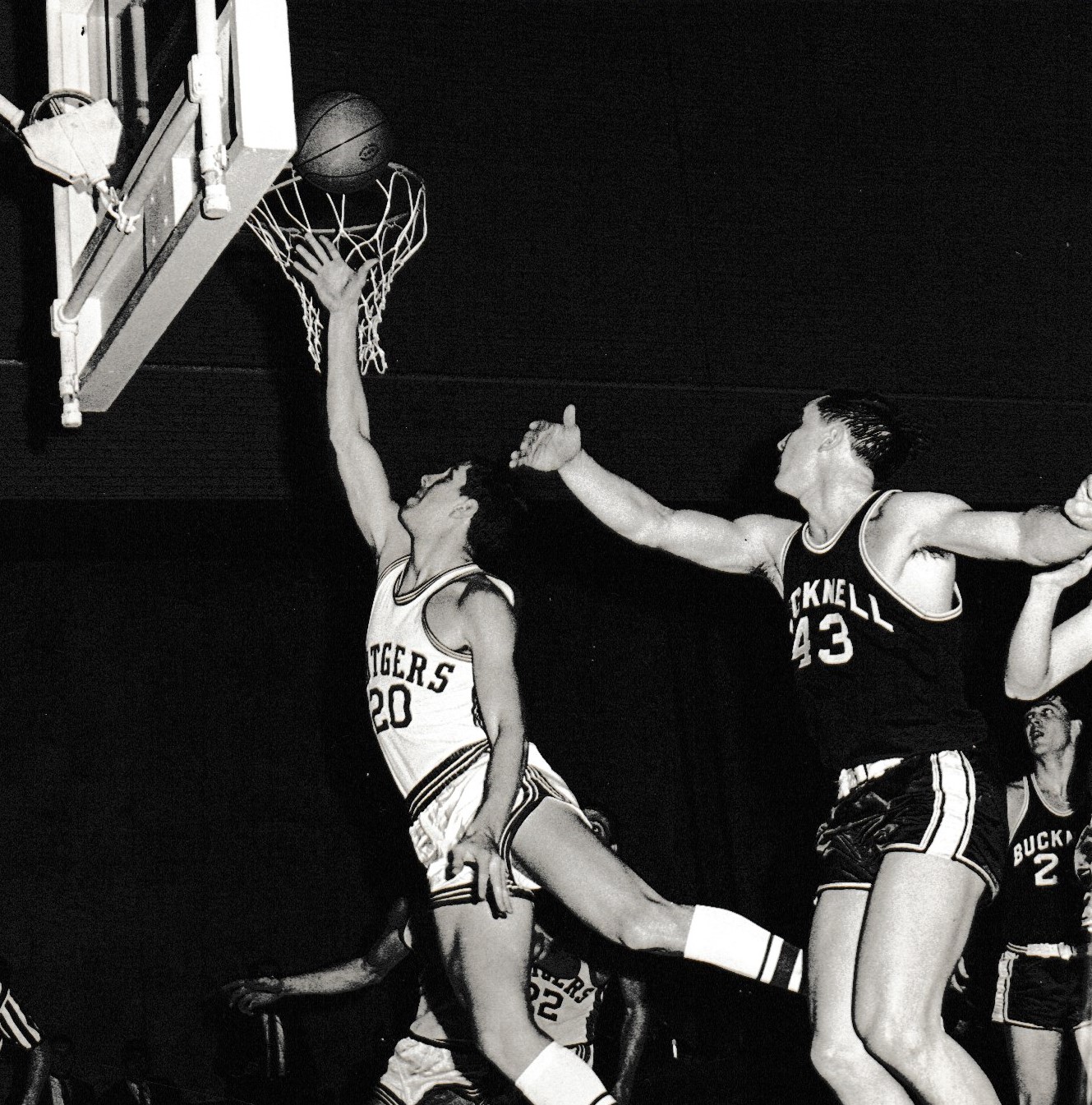
 I was greatly saddened to learn of the death on January 19th of  Lou Goetz, a three time Rutgers basketball letter winner and my long time friend.  Lou and I first met when we were freshman at Rutgers in the fall of 1964, he was the first of my many Rutgers basketball friends.  At the time freshman were not eligible to play varsity basketball so he played and I managed on the last Rutgers freshman team coached by Bruce Webster, a unique experience in its own right.  Lou had to sit out the following year due to illness, but he returned for the 1966-67 team and was a valuable reserve on the great Lloyd-Valvano led 1967 NIT team.  Lou started every game over the next two seasons and was an extremely important part of the 1969 NIT team.  For that season, Lou, at 6' 1," moved to forward where he always played at height disadvantage.  In spite of that challenge, his ability to contribute in ways that don't show up in the box score was a major reason why basically the same roster improved from 14-10 to 21-4.  In the process the 1969 team won 16 straight (the second longest winning streak in school history) and finished with the second highest winning percentage in over 100 years of Rutgers basketball (.840). 
 

Lou laying one in against Bucknell in February of 1968

In a February 1969 interview with the Rutgers Targum, Coach Bill Foster explained that even though Lou only averaged about six point per game he was invaluable because "he plays one way - aggressively."  The possible problems caused  by Lou's lack of size at the forward's spot, didn't bother Foster because Goetz "makes up for his lack of height with hustle."  Equally important was the fact that Lou was "one of the most unselfish players I've ever seen."  With those comments, it's no wonder Foster wanted to keep Lou around after his playing days were over.  After graduation, Lou became one of Foster's assistants at Rutgers and followed him to both Utah and Duke.  During the 1978-79 season, Lou and former Rutgers player and coach Bob Wenzel were on the coaching staff of Duke's NCAA runner-up team, a season immortalized in John Feinstein's Forever's Team.  Lou finished his coaching career as the head coach of the University of Richmond.


Lou with his (and my) longtime friend Steve Weinstein at the 50th anniversary of the 1967 NIT team

Lou's death brought back a lot of memories of our times together at Rutgers.  I remember a freshman game at Manhattan College played in a gym so decrepit that there aren't enough adjectives to describe how bad it was.  Suffice to say the scoreboard clock didn't go any higher than 10 minutes probably dating back to the days when college basketball played 10 minute quarters.  As a result the time was kept at the scorer's table for the first ten minutes of each half and then the scoreboard took over.  During a foul shot in the second half, Lou, who was on the court, asked me on the bench, "How much time is left?"  Thinking he didn't know the clock was working, I responded - "The scoreboard's working."  He said, "I know, but I can't read the numbers from here."  It was probably no surprise that not long after he began wearing contact lens.  In fact, it was his success with them, that led to my getting them, so among other things, I owe over 50 years of better eyesight to Lou.  

Lou with the late Dick Stewart (far left) and Jack Penhall

Four years later during a game against Dartmouth, then coached by Dave Gavitt, Rutgers put on one of those second half spurts that causes the other team to call timeout.  Caught up in the excitement, Lou ran from the floor into the huddle, yelling "Let's run them out of the gym."  It was an admirable sentiment, but since the "gym" in question was Madison Square Garden, his word choice was less than memorable.  Needless to say, he heard about that for a few days afterwards.  Later that same season we were playing a Bob Knight coached Army team at West Point.  If there is a worse experience in college basketball, I don't want to know about it.  Down late in the second half, Lou guarded the man bringing up the ball so relentlessly that he forced a 10 second violation.  It would be nice to say that it was the turning point in a Rutgers come from behind victory, but it wasn't.  A day or so later, however, Lou said me the play made him ask himself - "Why can't I do that all the time?"  In some ways that sums up Lou Goetz both as a player and a person.   He worked relentlessly at whatever he did, analyzed what happened and used what he learned to improve.  Lou Goetz was a credit to his team, his university and everything he touched - may he rest in peace.


Wednesday, January 13, 2021

What Goes Around - Rutgers 70 - Temple 68


A week before Christmas of 1982, the Rutgers men's basketball team was in Lexington, Kentucky to play in the University of Kentucky's annual holiday tournament.  Although out of fashion today, such events were long a staple of college basketball.  Typically four team affairs, these tournaments gave the host team an opportunity to play two additional home games while offering the visitors a trip and, in this case, the opportunity to take on one of college basketball's most storied programs.  Rutgers hopes were high for the 1982-83 season, the prior year Rutgers had won 20 games and made it to the second round of the NIT.  Thus far, nothing had happened to diminish those hopes, Rutgers was 5-0 with a win over archrival Princeton.  Hoping to play Kentucky in the championship game, the Scarlet Knights took on Tulane in the opener.  Down 54-53, freshman Chris Remley hit a shot with 2 seconds left that seemingly gave Rutgers the win and a matchup with the Wildcats.  It was not to be, however, Tulane's Paul Thompson took a full court pass and hit an 8 foot baseline jumper as the buzzer sounded.  Instead of the dream matchup, Rutgers was relegated to the consolation game to play conference rival Duquesne in a game that didn't count in the conference standings.


Daily Home News - January 30, 1983

Recovering quickly from the discouraging loss, Rutgers came back to win six of its next seven before a two game losing streak gave the Knights a 11-4 record.  Next up was a Saturday January 29th afternoon game against Temple at the historic Palestra.  The 1982-83 season marked two college basketball firsts.  It was the year conferences began experimenting with the three point shot and also the legendary John Cheney's first season as coach of the Temple Owls.  Cheney's initial campaign in north Philadelphia had been marred by injuries especially the loss of big man, Granger Hall, leaving the Owls a guard dominated team led by Jim McLaughlin and Terence Stansbury.  As a result Rutgers had a height advantage which the Knights immediately exploited, jumping out to a 11-2 lead in the first five minutes.  However turnover problems (13 in the first half) and the shooting of the Temple's guards quickly cut into the lead.  At the end of 20 minutes, Rutgers led only 35-33 in spite of shooting 50% from the floor and enjoying a 24-10 rebounding advantage.  After the break, the Owls quickly caught up and took the lead with just under 18 minutes left in the second half, an advantage they would hold for the next 12 minutes.


Philadelphia Inquirer - January 30, 1983

Temple led 62-54 with just under 8 minutes left with Rutgers big men Roy Hinson and Clarence Tillman both on the bench with four fouls.  Rutgers was far from done, however, Kevin Black began the comeback with a finger roll and a  foul shot to cut the margin to five.  Back in the game, even with four fouls, Tillman forced a turnover and then hit a three pointer as the shot clock was winding down.  It was now a one possession game and after Temple again came up empty, Black hit two more foul shots to tie the game at 62-62 with 4:30 left.  Temple broke their scoreless streak with a foul shot, but Rick Brunson's jump shot gave Rutgers a one point lead, its first advantage since early in the half.  Temple responded when McLoughlin hit a three pointer of his own and the Owls led 66-64.  With just 1:43 left, Roy Hinson was fouled and made both to again tie the game.  On Temple's next possession, Brian Ellerbe deflected the ball to Brunson who hit another clutch shot to again put Rutgers up by two 68-66.  Down two with just over a minute to play, Temple knotted the game once more on a Kevin Clifton jump shot.


Camden Courier Post - January 30, 1983

Holding the ball for the last shot, Rutgers took timeout with 23 seconds left.  Coach Tom Young drew up a play to go inside to Roy Hinson and exploit the Knights height advantage, but it wasn't there.  With time running down, Brunson passed to Ellerbe who was the second option on the play.  Shooting from a point the Philadelphia Inquirer called near the NBA 23' 9" line, Ellerbe drained a shot which according to the paper "everyone but the officials thought was a three pointer."  In spite of a long protest by Coach Young, the lack of instant replay made it impossible to check whether Rutgers was up three or two.  In the end it didn't matter even though just like the Tulane game, there were two seconds left on the clock.  This time a long pass went out of bounds, Rutgers had a buzzer beating win and Brian Ellerbee had the first winning basket of his career at any level.  


Brian Ellerbe 

The win marked the beginning of a nine game winning streak that put Rutgers in a good position for the post season.  Ironically, in a rematch with Temple in the semi-finals of the Atlantic Ten tournament, the Owls got a revenge victory.  It wasn't enough, however to mar the Knights season which was rewarded with an NCAA bid and an opening round matchup against South Western Louisiana.  Rutgers defeated the Raging Cajuns, the Scarlet Knights last NCAA victory, before falling to St. John's in the second round.  Brian Ellerbe went on to a long college coaching career including being the first African-American coach at Loyola University of Maryland and the University of Michigan.  Brian holds the Rutgers and Madison Square Garden records for assists in a game, 16 against North Carolina State on December 27, 1984.  The 1982-83 team finished the season with a 23-8 record, the 23 victories put them third in total wins behind the 1976 (31) and the 1978 teams (24).  It is a team and a season to be remembered.      

Thursday, January 7, 2021

Practice Pays Off - Rutgers 62 - Fordham 61

Although perhaps not equal to the metaphorical one thousand words, the above picture captures basketball's most dramatic moment - the buzzer beating shot attempt.  Time has run out, but since the ball is in the air, the shot's outcome will spell the difference not just between victory and defeat, but also between a moment to be treasured and one that can't be forgotten no matter how hard we try.  Like no-hitters in baseball or goal line stands in football, basketball buzzer beaters are relatively rare. Indeed some college teams go through an entire season or seasons without such moments.  There is probably no logical explanation for how or why they occur, such moments are opportunities that as Shakespeare said "taken at the flood leads on to fortune."  And regardless of how they happen, they deserve to be remembered and celebrated.  To that end, the 2021 version of this blog will focus on 10 such moments in Rutgers basketball history.  For our purposes, a buzzer beating shot is defined as one that either won the game or set up a game winning foul shot.  For the most part the shot ended the game and there is a limit of one buzzer beater per player.   


Bob Greacen laying one in against Delaware - Daily Home News

Rather than trying to rank the ten games, they will appear in chronological order beginning on February 27, 1969, when Rutgers hosted Fordham at the College Avenue Gym.  While known today as "the Barn," at the time, it was simply the Gym, considered outdated in many ways, but a major home court advantage.   Visitors sometimes asked if the court was regulation size.  It was, but didn't always seem that way due to the fans, primarily students, sitting right on top of the action.  Capacity was listed as 2,800, but it was probably more the number who could be squeezed in without unduly upsetting the fire marshal.  The 1969 team was a senior led squad, a number of whom had been a major part of the 1967 team, the first post World War II Rutgers basketball team to gain national attention.  Heading into the Fordham game, the 1969 team was well on its way to a return to the NIT thanks to a 17-3 record and a 12 game winning streak.  At the time, the NIT had far more prestige than today.  Only about 25 teams made the NCAA tournament so there were roughly only 40 post season opportunities available for 300 or so teams.  In addition, all the NIT games were played at Madison Square Garden when it was truly the Mecca of college basketball.  Some teams actually declined an NCAA bid to play in the NIT.


Rutgers Daily Targum - February 28, 1969

Like Rutgers, Fordham, 15-7, was hoping for an NIT bid.  As usual the Gym was packed and the atmosphere became even more intense thanks to 100 or so Fordham students who tried to hassle the ushers. Since the ushers were Rutgers football players that didn't go well for the visitors.  Next the Fordham mascot tried to harass Bob Greacen, Rutgers leading scorer during the pre-game warmups.  Today that probably would have earned Fordham a technical foul, instead it just ratcheted the intensity up even higher if that was possible.  The first half was close throughout, but at the break Rutgers led 36-31.  The lead didn't last long, however, as Fordham went ahead with 14:00 left in the second half and led by six, 59-53, with three minutes left.  Rutgers had struggled to score throughout the second half, making only six baskets, four by Dick Stewart, team captain and second leading scorer.  Fortunately, Greacen got hot at the line and made five of six foul shots to bring Rutgers within one with just over a minute left.  After Fordham failed to score, Greacen was fouled again and made both shots for a 60-59 Rutgers lead.  With 30 seconds left Fordham missed their initial shot and a follow up, but Ken Crucius rebounded his own miss and scored to give Fordham a one point lead.


Daily Home News - February 28, 1969

Ten seconds remained in the game and Coach Bill Foster took a time out to set up a play.  Bob Greacen remembers that in the huddle Foster asked Dick Stewart if he wanted to take the last shot.  In typical selfless fashion, Stewart said "Greek's hot, let him take it."  Stewart inbounded the ball to John McFadden who dribbled across midcourt and passed the ball to Greacen.  With the seconds counting down, "Greek" took one dribble, faked and took a 19 foot jump shot from the right of the key, aiming to bank it in off the backboard. It was, "Greek" remembered, a shot he had practiced a thousand times in his backyard and all the practice proved to be more than worth it.  The ball went off the glass and swished through the net as the buzzer sounded.  Greacen was mobbed, not only by his teammates, but students who stormed on to the court, led by football star and Rutgers Athletics Hall of Fame member Bruce Van Ness.  They lifted "Greek" on to their shoulders while the Gym echoed with chants of "NIT, NIT, NIT."  Fordham was understandably heart broken by the result, but in the end they also received an NIT bid.   


Although taken in an earlier game against Columbia, this is basically the shot Greacen took to beat both Fordham and the clock.  

In addition to the last second heroics, it was a remarkable night for Greacen who shot eight of sixteen from the floor and an incredible 15-17 from the line (88%) for 31 points, just over half of Rutgers total.  The win was Rutgers 13th in a row and they added three more for what was then a school record 16 straight.   Although the streak and the season ended with a loss in the opening round of the NIT, the team's 21-4 record is the second highest winning percentage (.840) in Rutgers men's basketball history, topped only by the Final Four team which also had the longest winning streak at 31.  Bob Greacen was the first choice in the second round of the 1969 NBA draft, chosen by the Milwaukee Bucks who took Kareem Abdul Jabbar in the first round.  Greacen played two seasons for the Bucks and was a member of the 1971 NBA championship team.  After playing briefly in the ABA, Bob embarked on a long teaching career in Allentown, Pennsylvania.  He holds the College Avenue Gym record for points in a game (46) and is tied with Eric Riggins for baskets in a game (19). Bob is a member of the Rutgers Athletics Hall of Fame.


Thursday, March 5, 2020

Afterwards

Although he didn't get to enjoy it in person, Frank Hill built a memorable team in just his fifth season at Rutgers.  Some may have thought it was a one time thing, but just two years later, Rutgers received not one, but two post season invitations - to a larger 32 team AAU event and a new eight team college tournament (not the NCAA).  This time, unmoved by student petitions, the faculty declined both opportunities citing the expense, time lost from class and the risk of over commercializing the sport.  Undeterred, Hill's 1923 team won even more games, finishing 11-3 with eight straight wins to close out the season.  After the 1922 season, Hill gave up the St. Benedict's Prep coaching job and did the same at Seton Hall University in 1930 to concentrate on his work at Rutgers.  All told Hill's college teams won 415 games at both New Jersey colleges with a .640 winning percentage.  He is a member of the athletic hall of fame of both institutions as well as St. Benedict's Prep.  Hill was also a highly regarded referee for 35 years.  He retired from Rutgers after the 1943 season and died on August 22, 1944 at the age of 65.   His grandson, Chris Hill played basketball at Rutgers in the early 1970s before an very successful career as Athletic Director at the University of Utah.


Frank J. Hill 

Both seniors on the 1920 team, Leland Taliaferro and Calvin Meury received well deserved recognition for their achievements at Rutgers when both were elected to Cap and Skull, Rutgers highest honorary society.  After graduation, Taliaferro attended Columbia Law School and worked first in private practice before beginning a long career at Public Service.  He died relatively young at the age of 55 on August 5, 1952.  Meury also pursued further education after Rutgers, attending the New Brunswick Theological Seminary and was ordained a minister in the Dutch Reformed Church, the denomination that founded Rutgers.  After serving long pastorates at churches in Syracuse and Schenectady, he became National Youth Director for the Church in North America.  On his death in 1985, Meury asked that memorial gifts be made to support athletic scholarships at Rutgers.  Art Hall, the sole junior on the 1920 team was chosen captain of the 1921 team.  After graduation, he had a long career in business both in the food industry and real estate.  His son, Frederick Arthur Jr graduated from Rutgers in 1953.


Calvin Meury

As noted earlier, Walter French was one of the greatest athletes ever to play at Rutgers, but is largely forgotten today because he left Rutgers after his sophomore season to enroll at West Point.  Under the rules of the day he had four more years of eligibility and could have played college sports for six years.  French enjoyed football success at West Point, but academic problems forced him to leave the academy.  On the brink of enlisting in the army, the Moorestown product was offered the opportunity to play minor league baseball which began a journey that led him to Philadelphia Athletics where he hit .305 in 1926 and was a reserve on the A's 1929 World Series championship team.  While a member of the Athletics in 1925, French played professional football for the Pottsville Maroons in the National Football League and was a key contributor when his team defeated the Chicago Cardinals for the 1925 championship.  Although the title was vacated on a technicality, French is the only player to be part of a World Series and NFL championship team.  French served with distinction in the army in World War II, became baseball coach at West Point and was named an honorary member of the West Point Class of 1925.  He died on March 3, 1984.


Leland Taliaferro 

The sole freshman on the 1920 starting five, Edward Benzoni was the first four year basketball starter in Rutgers history.  The second leading scorer on that team without taking a single foul shot, the Union Hill product used his 1920 success as a springboard to becoming the greatest offensive player in the first 30 years of Rutgers basketball.  By the time he graduated in 1923, Benzoni had set records for points in a game (three separate times), points in a season and points in a career among other achievements.  Most of his records stood until the late 1940s.  Especially impressive was his junior season when he became the first Rutgers player to average 20 points in a season, a major achievement in that low scoring era.  He stood alone in that category until the 1950s and remains one of only 13 Rutgers players to average 20 points per game.  Benzoni was the captain of the 1923 team and like Taliaferro and Meury before him was elected to Cap and Skull as a senior.  After a brief period of professional basketball, Benzoni worked in a family business until his death in March of 1966.


A century has passed since the 1920 team first brought national recognition to Rutgers basketball.  Not only was it a very different time, Rutgers was a very different school and basketball was a very different game.  Indeed its hard to know who would experience more cultural shock, today's players transported to the school and game of 1920 or those long ago athletes experiencing today's state university competing in a premier athletic/academic conference.  At the same time, however no matter how different the uniforms, both teams wore the red jerseys of Rutgers basketball.  Besides school colors, however, there is another thread that connects all Rutgers basketball teams, the potential to bring positive recognition to the school.  Even in that more limited communication age, the 1920 team's achievements attracted media attention from Florida to California.   Be it the 1920 team or this year's squad, a century later, the words of George Harrington Rutgers Class of 1898, an eyewitness to the 1920 AAU tournament, still apply.

      "Rutgers name today stands in the South and has been published to the entire country
        at the very top, and this the boys have won for their Alma Mater by being themselves,
        and that is true gentlemen.  They have honored themselves: they have accredited
        their college.  No one could ask for more."

May it always be so!


Tuesday, February 25, 2020

The Tournament

Although the Rutgers players were doubtless excited about the trip to Atlanta, some of the glamour probably wore off during the 30 hours it took them to reach the Gate City.  The challenges of travel may at least partially explain why they declined numerous invitations to play games in route in places such as Nashville or Louisville.  Regardless, it must have been a tired group that arrived in Atlanta at 6:30 am on Wednesday morning where they would be hosted by George Harrington RC of 1898, a "staunch and enthusiastic alumnus."  After checking in at the Ansley Hotel, the team practiced, enjoyed a tour of the city and took in an movie on their one free night.  During the stay in Atlanta graduate manager Frederic Heitkamp planned to tour area high schools to promote Rutgers and encourage applications from area residents.  The collegians from New Brunswick were one of five college teams in the tournaments along with 11 AAU clubs, many boasting former college players on their roster.  The presence of so many veteran players may explain why Rutgers was the youngest (average age 20) and lightest (average weight 155) in the event.


Home News - March 2, 1920

To date Rutgers had played only two road games, short train rides from New Brunswick. Now over 800 miles from home, at a supposedly neutral site, their opener would be a virtual road game against the University of Georgia.  It was probably no surprise therefore that Rutgers got off to a slow start in the game at the Atlanta Auditorium, trailing by three points at halftime, down six with 10 minutes left and still behind in the "last few minutes."  At that point, however, the northern squad made a"wonderful spurt," led by Benzoni who "time and time again" avoided the Georgia defense, making "spectacular shots from difficult angles."  According to Atlanta sportswriter Gene Hinton, on one occasion, the Rutgers forward with his back to the basket, "flung the ball over his head" and through the net.  Also making a major contribution was Taliaferro who, in spite of a leg injury, contributed 14 points towards Rutgers 36-33 win.  Hinton called the game the "most heart fought battle of the first round."


Edward Benzoni

The following evening the Rutgers squad was back on the court to take on an undefeated Utah team, although the Salt Lake contingent had only played five games.  Once again Rutgers fell behind in a game Gene Hinton of the Atlanta Constitution called "equally as bitter" as the Georgia contest.  Utah's lead grew to eight points, but late in the second half, "a young cyclone," named Edward Benzoni erupted.  The Rutgers freshman standout had been shut out in the first half, but he went on a 10 points tear to lead his team to a 35-32 victory.  Also making a major contribution on offense was Leland Taliaferro who score 17 points including making 11 of the teams 17 attempts from the free throw line.  It was wrote Hinton "a hard game to lose" for Utah and an equally "hard game to win" for Rutgers.  With two close wins in two games, Rutgers was now in the semi-finals.


Walter French 

In the first two games, the five Rutgers starters had played all 40 minutes.  Now faced with their third game in three nights, they had to stop the two top scorers of the Detroit AAU team, Joe Dermody, who had averaged 23 points in the first two games, and Walter Voss who had put in 18 per game.  While Taliaferro and Benzoni continued to lead the offense, Walter French keyed the defense which put the clamps on the Detroit stars.  Gene Hinton claimed "the white jerseys of Rutgers were everywhere"  and Detroit seemed "powerless," against "the leech-like tactics."  Whatever the strategy it clearly worked since Dermody managed only nine points while Voss was held scoreless.  All five starters went the distance for the third consecutive night and Rutgers earned the right to play "for the championship of the United States."


While not of high quality, this picture shows the Rutgers team at the championship banquet with the second place trophy.  The trophy was most likely destroyed by a fire at Ballantine Gym in 1930.

Atlanta Constitution - March 17, 1920

Rutgers had one unexpected benefit in the final game.  After seeing their local school fall to Rutgers, students from Georgia and Georgia Tech decided to root for Rutgers assisted by graduate manager Heitkamp who "taught them the old familiar college yell and they used it with a vengeance."  Unfortunately all the moral support in the world wouldn't have mattered as waiting for Rutgers in the championship game was NYU.  Although Rutgers was in the game at halftime, NYU broke it open in the second half, winning 49-24.  After the game both teams attended a banquet at the East Lake County Club where Rutgers received the second place trophy.  Shortly thereafter, the Rutgers party left for the return trip to New Brunswick, arriving for noon chapel services on Monday where they were warmly received by their fellow students and President William Demarest.   Rutgers received no end of accolades from the Atlanta media beginning with Keller Morton of the Atlanta Constitution who claimed there was "no doubt but that Rutgers was the most popular team" in the event.  Although he mixed metaphors (or sports), Morgan Blake, the paper's sports editor said "Rutgers will fight with a superb courage until the last man is out in the ninth inning."